EXPERIMENT 003 · GENERATIVE STRESS TEST
Sharper. But still the same person?
Let learned image and face priors fill the gaps, then inspect what changes. A separate creative derivative of the same small source.
Face reconstruction is ON here. Real-ESRGAN enlarges the 320 × 180 master 4×; GFPGAN v1.4 then reconstructs detected faces. No identity guard or temporal model is applied. This is an aggressive GAN example, not a claim about the strongest available generative video model.
Apparent detail can be invented. This output is presented for inspection and has not been accepted as a faithful family-video restoration. The original Lanczos / RealESRNet experiment remains separate.
Loading separate experiment…
Where does it drift?
Observed in matched crops: the GAN result has crisper edges and textured skin, while fine facial markings and the mouth differ from the reference. At 2 seconds a juggling ball overlaps the face; that ambiguity makes the reconstruction especially unreliable. A crisp-looking patch is not evidence that the missing feature was recovered.
Use these moments to compare the source evidence with the generated result. The input crop first uses 4× nearest-neighbour enlargement; each matching 720p crop then uses 2× nearest-neighbour display enlargement. The original is reduced to 720p with Lanczos. No generative processing is applied to the reference or inspection sheets.
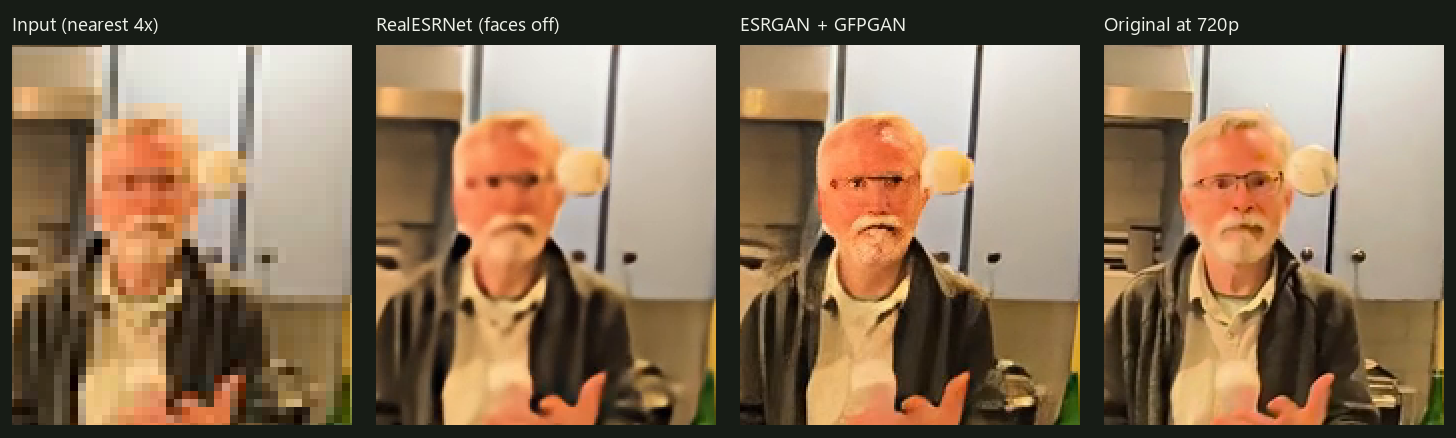
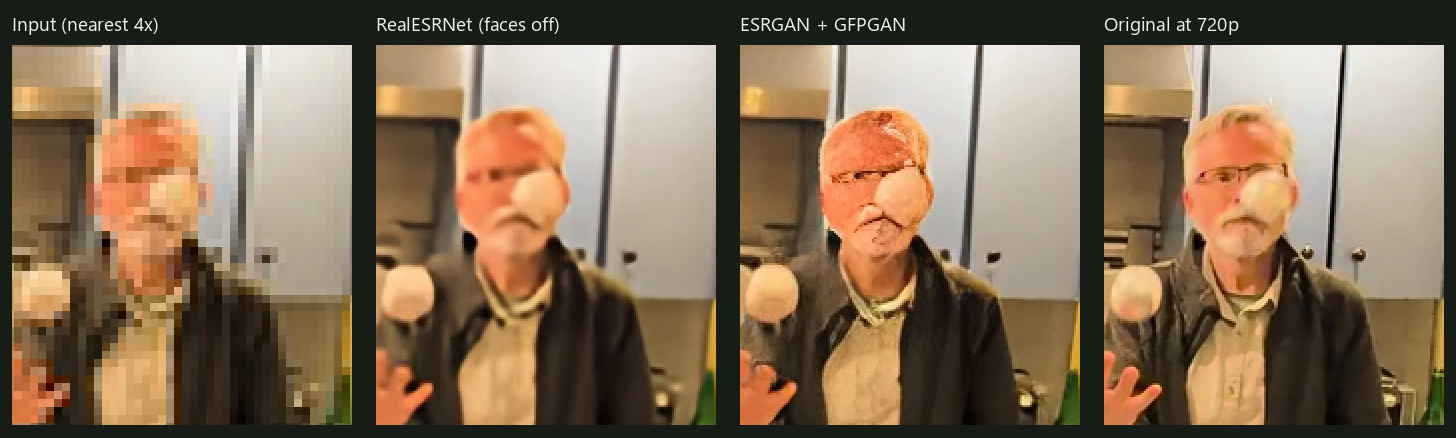
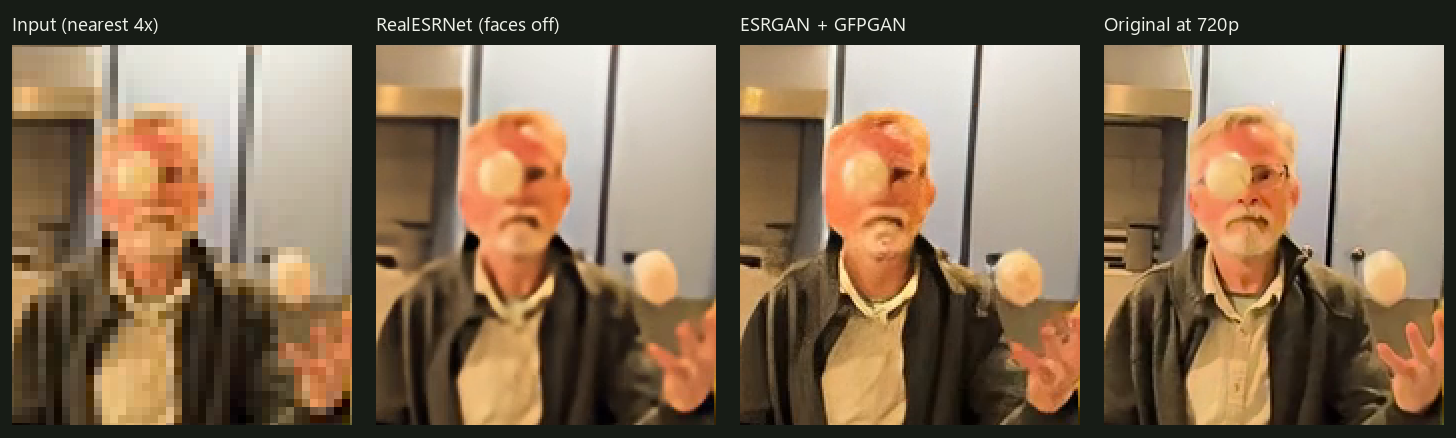
Three spot checks cannot establish identity fidelity across a video. Review the synchronized clip for changes in expression, glasses, mouth, skin texture and flicker. Final acceptability is a human judgment.
What was actually run
Full 251-frame clip · RX 6700 XT · Windows ROCm · FP32. Processing and encoding took 113.89 seconds, plus 2.15 seconds model loading in this individual run. GFPGAN reconstructed a detected face in 235 of 251 frames; 16 frames use the Real-ESRGAN result without face reconstruction. Detection changes may contribute to flicker. Face reconstruction uses standard GFPGAN v1.4 clean pasteback. A fixed noise seed is reset per frame; frames are otherwise processed independently. No interpolation, audio, identity swapping, or additional sharpening pass.
Settings, model hashes, face counts and measured runtime ↗ · Download silent generative result ↗
The models use learned priors, rather than measuring the missing detail from this recording. This test uses Real-ESRGAN and GFPGAN. It does not test diffusion video restoration or establish a maximum possible deviation.
SEPARATE GENERATIVE MEASUREMENT
What does face reconstruction change?
| Method | Whole PSNR (dB) | Whole SSIM | Face-region PSNR (dB) | Face-region SSIM |
|---|---|---|---|---|
| Real-ESRGAN · faces off | 29.58 | 0.9173 | 27.11 | 0.8722 |
| Real-ESRGAN + GFPGAN · faces on | 29.57 | 0.9171 | 26.97 | 0.8680 |
The same Real-ESRGAN weights precede both outputs. The second then applies GFPGAN. In this clip, face reconstruction slightly lowers PSNR and SSIM, including in the fixed face region. The small whole-frame difference is expected when the altered face occupies little of the picture; it does not establish identity fidelity.
Same reference, frame alignment and export-aware methodology as the main report. These are similarity scores, not identity or flicker scores. The comparison isolates the added face-processing stage; it does not prove every pixel or kernel run is numerically deterministic.
Main fidelity and motion report ↗ · All per-frame results and limitations ↗